


Which groups must contain 1 to 9?
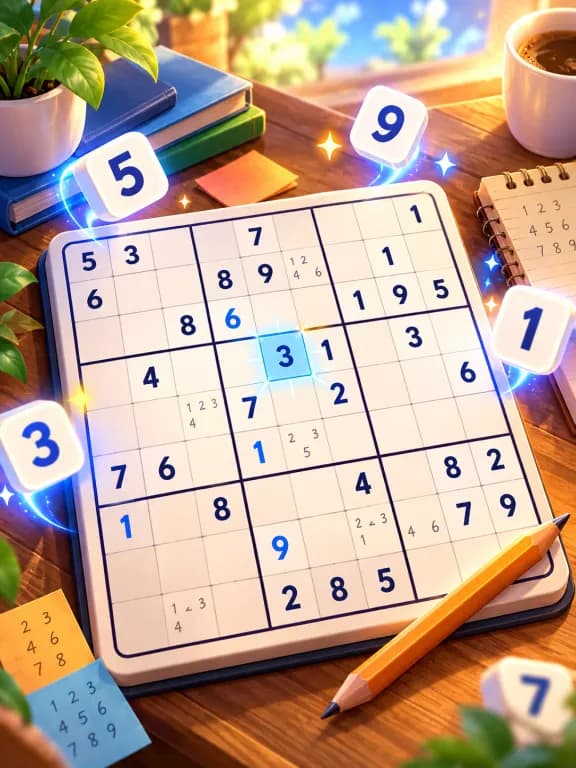
The board has 81 squares: nine rows across and nine columns down. Thick lines divide it into nine smaller boxes, each three squares wide and three squares high. Every square belongs to one row, one column and one box.
A completed row must have nine different digits. The same is true of every column and every box. A row that looks correct can still be part of an invalid board if one of its numbers repeats in a column.
Can you change the starting clues?
No. The starting digits are part of the puzzle, not guesses to replace. Fill the initially empty squares around them. In our game, fixed clues and correctly entered answers are locked against editing.
The two long diagonals do not have their own all-different rule in the standard Sudoku described here. A digit can appear twice on a diagonal if its row, column and box constraints are still satisfied.
Is an allowed number necessarily correct?
A candidate is a number not ruled out by the digits currently visible in a square’s row, column and box. Several candidates can remain for the same square. Being allowed by those immediate checks does not prove a candidate is the puzzle’s answer.
For example, if a row is missing 2 and 7, those are only the starting possibilities. A 7 already in the target square’s column removes 7 there, leaving 2. You must also check the box.
For a full worked grid and two basic deductions, see our beginner Sudoku techniques.
What is the difference between notes and answers?
Notes are small reminders of possibilities. They do not fill the square or complete a group. In PaperFox Sudoku, turn NOTES on to add or remove pencil marks, and turn it off before committing a normal-sized answer.
A wrong committed answer costs one of three hearts. The game checks it against the puzzle’s solution, so a locally plausible guess can still be marked wrong. Use notes while uncertain instead of trying alternatives as final answers.
Read the Notes controls guide if a tap produces a large number when you expected a small candidate.
How do you finish a puzzle?
Every square must contain its correct digit. Leaving pencil marks in the remaining cells is not a completed puzzle. Scan the affected row, column and box after each placement rather than checking only at the end.
Our game offers Easy, Medium and Hard puzzles and a daily puzzle. Difficulty changes the puzzle you solve; it does not add new winning rules. Open Sudoku below and choose Easy while learning the three constraints.
Questions
- Do diagonal numbers have to be different? Not in standard Sudoku. The restrictions apply to rows, columns and 3×3 boxes. Diagonal Sudoku is a separate variation.
- Can the same digit appear in two different boxes? Yes. Every box needs all nine digits, provided the repeated digit does not share a row or column.
- Do pencil marks count as filled squares? No. They record possibilities. You still need a confirmed answer in every initially empty square.