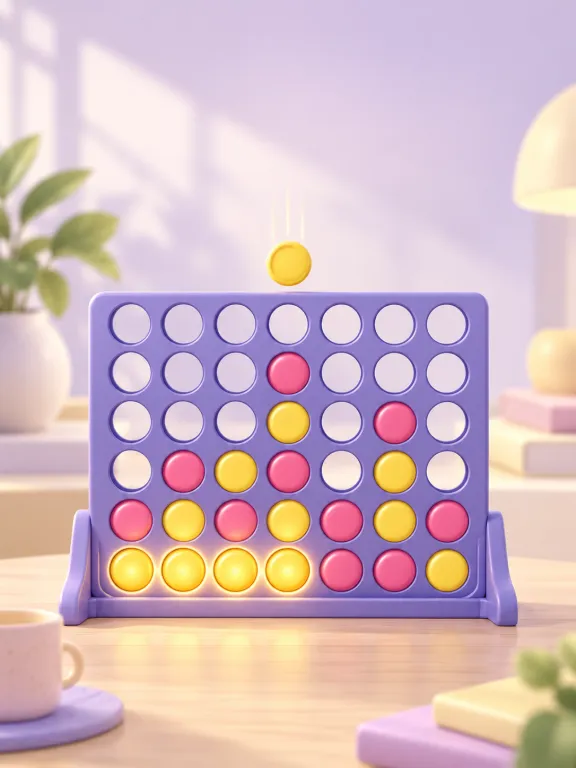



What happens on one turn?
Choose a column that still has room and drop one disc. Gravity determines the row: you cannot choose a floating square or insert a disc below an existing stack. Then the other player takes a turn.
In our touch controls, slide to aim the disc above the board, then release to drop it. In friend mode, the turn indicator tells you whose colour is active. This is turn-based play on one phone, not a race to tap first.
Which groups of four count?
Four adjacent discs of the same colour count across a row, down a column or along a diagonal in either direction. The line must be straight and uninterrupted. Four discs scattered around the board do not count, and a gap breaks a line.
A diagonal still needs physical support. A disc cannot be placed in the air merely because that square would complete the pattern you want. You may need earlier drops to build the stack beneath it.
What if a column is full?
A column with six discs has no legal space for another drop. Choose a different column. Existing discs stay in place for the round: you do not remove the bottom disc or slide the stack sideways.
When the whole board fills without a winning line, the round is a draw. If the final available drop completes four in a row, it wins rather than becoming a draw.
What should a beginner watch for?
Before building your own line, check whether you can win with the next drop. If you cannot, check whether the opponent has a legal winning drop. A visible gap matters only if a disc would actually land there.
For example, three opponent discs across the bottom row with an empty neighbouring bottom square need immediate attention. A similar-looking threat several rows above empty space is different because the next disc may fall below the intended square.
Treat this as a useful check rather than a promise of perfect play. Longer threats and competing winning drops can require looking several turns ahead.
Can you play a friend or the computer?
Our game offers a friend mode for two people sharing one phone and computer opponents at Easy, Medium and Hard. Changing computer difficulty changes its decisions, not the drop or winning rules. Hard is not described here as an unbeatable opponent.
Four in a Row is available in both Duo Games and Offline Games. For a shorter introduction to taking turns, try Tic-Tac-Toe.
Questions
- Do diagonals count? Yes. Four adjacent matching discs on either diagonal direction count, just like horizontal and vertical lines.
- Can I choose any empty square? No. You choose a column; your disc falls to its lowest empty space.
- Can two players play offline? Yes, in the installed apps’ local friend mode. Both people use one device, with no second phone or pairing required.