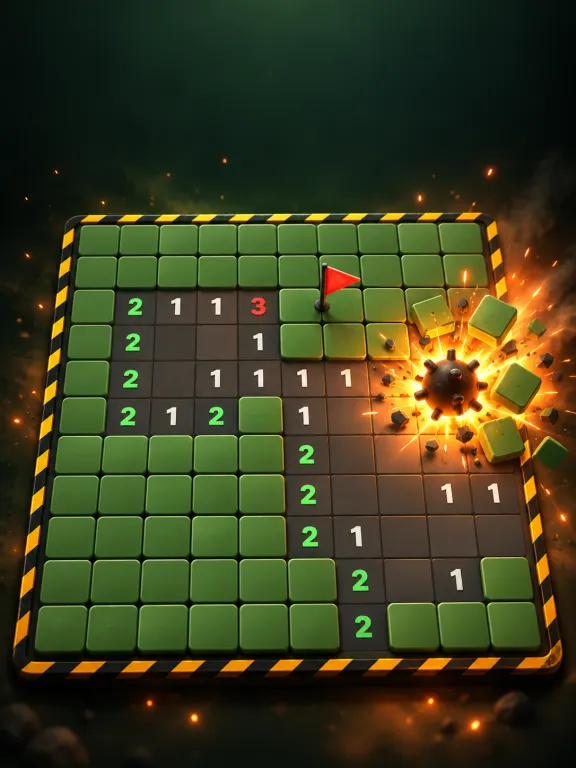



What does a number count?
A square can touch up to eight neighbours: left, right, above, below and the four corners. A clue of 2 means exactly two of those neighbouring squares contain mines. The number is not a distance or a direction arrow.
Edges and corners have fewer neighbours. A blank, zero-clue area has no mines immediately around it, so the game opens nearby safe squares and may spread across a larger area.
How do you place and remove flags?
Long-press a hidden square, or use FLAG mode, to mark a suspected mine. Toggle the flag again to remove it. A flagged square is protected from ordinary digging until you unflag it.
If a clue of 1 touches only one remaining hidden square and all its other neighbours are open, that hidden square must be the mine. If two hidden squares remain, the 1 alone does not tell you which one is mined. Use another clue before treating a guess as certain.
What does tapping an open number do?
When the number of adjacent flags matches a nonzero clue, tapping that open number clears its other unflagged neighbours. This shortcut is useful only when the flags are correct.
For example, a 2 with two correctly flagged adjacent mines can clear the remaining neighbours. If one of those flags is wrong, a real mine may be left unflagged and the shortcut can hit it. Matching the count is not enough to make an incorrect flag safe.
Is the first dig always safe?
In PaperFox Mine Field, yes. Mines are placed after the first dig and kept out of that square and its neighbours, giving an opening area. This is our implementation’s rule; first-click guarantees vary across other versions.
A safe start does not promise that every later position can be solved from the visible information alone. Avoid assuming every uncertain square has a deduction you have overlooked.
What changes with difficulty?
Easy uses an 8-by-8 field with 10 mines. Medium is 10 columns by 12 rows with 20 mines. Hard is 12 columns by 16 rows with 40 mines. The meaning of each clue and the objective stay the same.
Begin on Easy to learn the controls and how neighbouring clues overlap. A smaller field also gives you fewer squares to keep track of while checking your deductions.
Do you have to flag every mine to win?
No. The winning condition is opening every safe square. Flags are tools for keeping track of mines, not a separate completion requirement. A field with all suspected mines flagged can still be unfinished if a safe square remains hidden.
Our game includes a daily field and a hint that points to a safe hidden square. Open the game below to practise the rules; the hint is an aid, not an explanation of every deduction on the board.
Questions
- Do corner-touching mines count? Yes. Clues include all adjacent squares, including diagonal neighbours.
- Does a flag confirm a mine? No. A flag records your belief. An incorrect flag can make a clear-around action unsafe.
- Why have I not won after placing all my flags? Check for hidden safe squares. Winning requires opening every non-mine square, not simply using all flags.