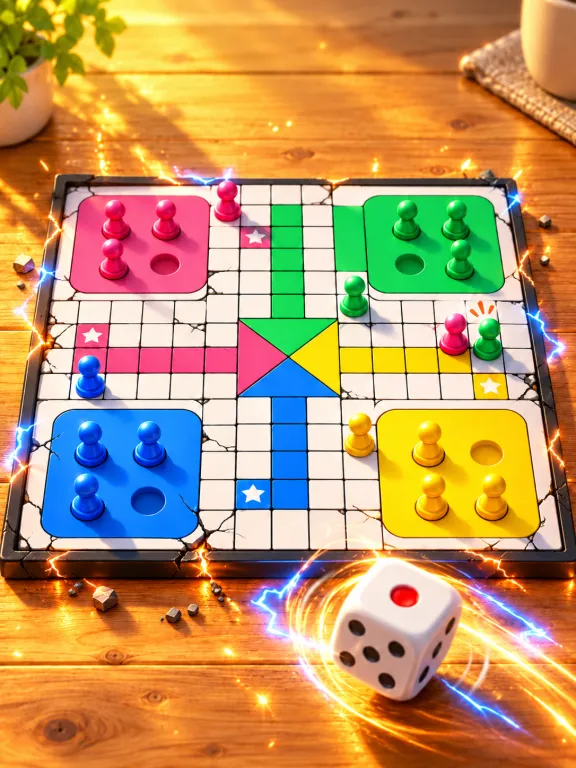



How do you set up a game?
Choose 2, 3 or 4 players. In Classic, each colour has four pieces; in Quick, each has two. All pieces begin in their colour’s base. The winner is the first player to get every piece into the middle.
For two players on one phone, choose VS Friend and two players, then take turns on the same screen. You can also play against the computer. Two players use opposite corners in our version.
Do you need a six to start?
Yes. A six lets you bring one piece out of its base onto its starting square. That uses the roll: the new piece does not also move six more squares. Alternatively, you can use the six to move a piece already on the board.
After a six, roll again. A new piece remains safe on its start square until it moves away. If there is no legal move on a non-six roll, the turn passes to the next player.
How do movement and captures work?
Move one piece the full value of the die. You cannot divide one roll between several pieces. Follow the shared track clockwise, then enter your own coloured home lane.
Land exactly on an opponent’s lone piece on an unsafe square to send it back to base. That piece needs another six to come out. Passing over a piece does not capture it. Capturing gives you another roll.
Example: an opponent is four steps ahead on an unsafe square. A four lands on it and captures it; a five passes over it and lands beyond it.
Which squares and pieces are safe?
- Start squares and stars: pieces cannot be captured on these squares, even when another colour lands there.
- Two pieces of the same colour together: our version protects them from capture. They do not form a wall that blocks movement.
- Your coloured home lane: opponents do not enter it, so your pieces are safe there.
When do you get another roll?
A six, a capture or getting a piece all the way home grants another roll, unless that move already wins the game. You still choose just one legal piece to move for each roll.
If you roll three sixes consecutively in the same turn, the third six ends your turn before you move. In our version, the earlier moves remain where they are; they are not undone.
Do you need an exact roll to finish?
Yes. If a piece needs two steps to reach the middle, it can finish on a two. A three overshoots, so that piece cannot use the roll; move another legal piece if you have one.
One finished piece is not a win. Finish all four pieces in Classic, or both pieces in Quick. Quick reduces how many pieces you must bring home; it keeps the same capture, safety and exact-finish rules.
Which rules are specific to PaperFox?
Ludo has regional and household variations. Before a physical-board game, agree on extra turns, safe squares, protected pairs and the three-sixes rule. The rules above describe our implementation, not every version of Ludo.
Our game also has a starting aid: when all your pieces are in base or already home, three rolls without a six make the next roll a six. It keeps a player from waiting indefinitely to re-enter. The same aid applies to every player, including the computer.
Play Ludo and choose your mode. For a physical board, our dice roller supplies ordinary random rolls; it does not apply the game’s starting aid or manage turns.
Questions
- Can two people play Ludo? Yes. Choose two players and VS Friend to take turns on one phone. Our two-player board uses opposite corners.
- Does capturing give another turn? In PaperFox Ludo, yes. You get another roll after a capture, after a six or after a piece reaches home.
- Do three sixes send a piece back to base? In our version, no. The third consecutive six ends your turn without a move; earlier moves remain in place.